Saturday, April 30, 2011

Sticks and Mud in San Roque, Peru


San Roque de Cumbaza, San Martin, Peru.
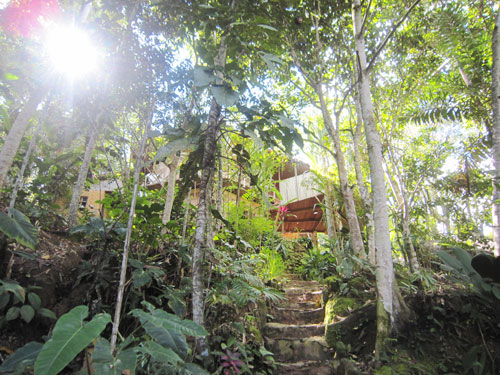
A view here in San Roque.

A pleasant river wraps between small mud houses covered in grey Shapaja palm leaves surrounded by the misty mountains of the high jungle. It´s not to hard to like San Roque at first site. Each day, however, reveals more secrets tucked in to the hidden corners of the land: pottery of the Lamistas, Cacoa and coffee chacras, mystical medicinal plants, high waterfalls, fireflies, monkeys, and of course the beautiful people who greet you with an hola and a warm smile always. I have been here going on 3 months now and below are some of the projects I have been involved or learned about here.


San Roque bridge
Mishkiyacu eco community here in San Roque
6 hour hike to insane waterfalls here.


Sachaqa Centro de Arte.

Sachaqa website

I first heard about this area through Trina´s art center. A sustainable artist’s retreat in the amazon, you say? Heck yeah I am going there. Trina, from England, has run the center for over 4 years bringing people from all over to have a beautiful and therapeutic place to practice art. Trina showed me how to make natural paints out of the river rocks, something that has been a dream of mine for a long time.

A new art center was being built as a part of a larger sustainable community. I happened to be very fortunate that they were just beginning to build this and another house out of the traditional local method called Quincha. The exact type of project I had been hoping to get my hands dirty in on my trip.


The Sustainable Community


Ana, a mother of three, is helping Trina add her art studio to a growing sustainable community on her land.

Joey, another volunteer, helps Luna go to the river to collects rocks to build.

Sachaqa Art Center
Just the frame of Trina's art center.

Almost finished!

The view isn't bad.


Quincha

Quincha is a traditional method of using caña brave to make an earthquake-proof frame covered in mud to build a light airy house perfect for the warm humid climate here.

Quincha Recipe:

  • A pile of Dirt
  • 1/3 water
  • rice leaves
  • banana palm stems shredded
  • Directions: mix all together and mash well with feet.

Long soft bricks can then be made by slapping globs of it into the mud until they are nice and thick. The long bricks are then hung over the caña brava and smoothed into a wall. Once dry another layer of mud and rice leaves is smoothed over. And there your have your eco house. Trina and Daniel hope to have the art center done soon to invite artists to this new site within the community.


Mashing mud

Wood secured with strips of bark
The caña brava frame is earth-quake proof
windows help lighten the monolithic structure
Glass bottle windows are a cheap upcycled way to get some light in too
Securing glass bottle windows in between the caña brava


Chirapa Manta

Javier and Claudia´s eco center, Chirapa Manta, is the other house we have been building out of mud. Even though it is out of mud, this is pretty luxurious eco-housing. There is a group of people here who are all friends and are striving to start green enterprises like this one to keep San Roque clean and sustainable and also help educate the people of Peru about the importance of our earth.

Javier says: “Here we all are teachers and we learn from everybody, even from the animals and plants... here there is no master, we are all together going through this beautiful adventure…”

The large structure is also caña brava


Artistic Details
Shells
Designs in the mud give it some glamour :)

Glass designs in the doorway.


Ñawpa Runa Non-Profit Project

Ñawpa Runa Facebook
http://www.nawparuna.org/

Trina´s husband Daniel is very involved in the arts, music, dance and traditions of the area. His Non-profit, Ñawpa Runa aims at preserving the indigenous traditions in ceramic works, handicraft such as: basket weaving, embroidery, knitting and folk dances, as well as the need to preserve the Quechua language. There is a women here with knowledge of local medicinal plants, healing ailments such as, arthritis, rheumatism, infections, intestinal worms, diarrhea, cancer, diabetes etc. She would like to teach people and have help documenting her knowledge. He also strives to teach practical topics in the production of Cacao, Honey, Coffee, Cotton, Beans, Riceon the local farms.

In the culture of these indigeneous people the basic element consists not in “development” but living in “equilibrium” within the numerous ecosystems and the order that exists between species of the great biodiversity that exist in the Amazon region.


Chazuta at susnset

A woman of 90 years works on the pottery in Chazuta, which is some of the most well made in the San Martin area.


Hunab-Ku

The medicinal plants around Hunab-ku

The roomy bamboo and thatched roof loft I have been living in is a part of Hunab-Ku, a spiritual center surrounded by a botanical garden with Amazonian medicinal plants. The construction of the center was realized according to the laws of sacred geometry using local and natural materials. I was told also that the elements of construction were meant to bring forth your path and especially for women your intuition. I have to say that I had a lot of vivid dreams here and everyone who slept here said the same .


Activies at Hunab-Ku

Bake day with the orno at Huab-Ku.


Shamanism, Ancient wisdom and the Origins of Life

San Roque is known for it’s traditional ayahuasca ceremonies. People from many countries fly here for a weekend just to have a ceremony. " Ayahuasca " is Quechua for "spirit vine" or "vine of the souls". It is a brew of the giant forest plant banisteriopis caapi mixed with psychotria virdis. Brewed for hours together, they have strong hallucinogenic properties that have been historically consumed by the western half of the Amazon valley and isolated tribes on the pacific slopes of the Ecuadorian and Colombian Andes. Unlike San Pedro, which deals more with the outer world of nature, ayahuasca is done at night and taps into cleansing your inner self which can be a terrifying experience revealing and releasing bad energy people hold inside. I have heard many things about the different experiences and revelations of those using ayahuasca as a therapy.

Most are struck immediately by vived hallucinations, some see images of the universe, the earth before life, the veins in their hand as the same as the veins in a leaf, a feeling of connection to all things, a clear vision of who they are, and almost all see terrifuing twisting snakes. They say that the snake is the mother of the ayahuasca .

Much of indigenous mythology claim to have come from auywaska visions as well as their unbelievably complex medicines created without access to modern science. The indiginous say the auywaska revealed many secrets of medicine to them.

A current belief is that somehow the plant allowed shamans to gain acess to biomelecular information. Most the images that appear over an over in indigenous mythology, which comes from ayahuasca visions, can be connected to the discoveries of modern science. According to Jeremy Narby´s book, The cosmic serpent: DNA and the origins of knowedge, imagery of twisting snakes occures over and over in visons and mythology as a symbol of the vital life force that the indiginous believe permeates every living thing. Narby sees this as metaphorical imagery of the double helix of DNA. Often this vital life force is seen as arrivng to earth from another place. An account from anthropologist in Peru during auywaska vision said they saw the world before life and how life came from cosmic origin of twin snakes landing on earth and mutating into many forms. The widley held belief that life spontanelously created itself on earth is also challenged by Francis Crick, co-discoverer of DNA. He wrote in Life Itself: Its origin and nature: That probability of change emergence of a single protein need to create DNA are in the odds of one in 20 to the 200th, this is enormously greater than the number of atoms in the observable universe (estimated at 10to the 80th)- Crick resolves that life “cannot have arisen by pure chance”. This evidence of life emerging from out side of earth struck me as very interesting. Whether or not the twisitng serpants truly represnt an ancient knowledge of DNA and that life came from another place is anybodys guess. However, it is undeniable that the indiginous have a deep understaning that there is a vital life force that connects us all and an incredible knowledge of the medicinal power of plants that cannot be lost.

A section of Auywaska growing in Hunab-Ku like twisitng snakes.

After learning a lot about shamanism and ayahuasca ceremonies I came to realize that most of it I had already learned in a few seconds from viewing one of Trinas paintings.


I talked with many people who have tried these cleanses and all said they found answers to something. It was reveled to a mother who had little time to play with her kids to look in their eyes deeply to make that connection with them. Others todl me stories that they were shown who they were and who they would be which helped greatly on there path of life.

OK mom and dad, before you get scared and think that I am wigging out on strange halluanagenic drugs in the jungle, don’t worry. I haven’t taken any. I feel that my path of enlightenment doesn’t include external medicines at this point in my life but other practices internal in myself. I believe that everyone has their own way and the ancient medicinal plants of the jungle are a fascinating history to learn about.


Indiginous of San Martin area

I have had some really great opportunities to work on some of the local farms and spend time with some indiginous families here. They still speak Quechua, the native dialect, and still tend the land like they have been for centuries. Below is Pantronilla, a Lamista who showed me the traditional technique of making pottery.

Here they don't have fancy wheels, they make rools and pinch each layer of clay together.
After the pot is done it is fired for a week.
Patronilla and I.

Patronilla with Marybelle in her traditional clothes.

Patronilla is 63 and still a hard worker.

The family invited me to stay for lunch.
The menu: farm fresh chicken soup, beans and plantains
Abuela linda

Selling pottery in the castle in Lamas

Really so much to see and do in San Roque though at first glance a sleepy little town tucked in the jungle. I will have more info on my art with natural paints soon!


Thousand Colors of Lamas project

THOUSAND COLORS OF LAMAS PROJECT

We are looking for artist that want to participate in this beautiful project.The Province of Lamas is located in the San Martin region of the Northern high Amazon of Peru.The objectives of the project are:

1- Contribute to promote the Culture values.
2- Promote the Cultural Values and bring the history to the local youth.

Goal of the project: Painting 120 mural with desings that describe the history, the traditional Culture and landscapes of Lamas.The sizes of the mural are approxameteky:
Wide: 6 mts High: 3 mts.
Your talent and creativity are greetly appreciated.We will provide you with housing and food in exchange for your help. For further information write to us at:manchas44@hotmail.com

Hosted by Sachaqa Center of Art


View over Lamas


Saturday, March 12, 2011

Leila's Finca, San Isidro, Ecuador


Finca San Pablo de LEA

San Pabalo de LEA is a milk farm located an hour or two east of the beaches of Jama, Canoa and Bahia. I spent two weeks here with Leila an energertic mother of two beautiful daughters Estephania and Amber. There are four generations on the farm and Leilas mother would cook us a traditonal and tasty lunch each day.

The work here was hard because of the heat but Leila is super laid-back and never made us work for too long when it was hot. Most of the work consisted of cutting pasto for the cows, milking the cows and creating a living fence out of Piñon tree. She also taught us how to make chocolate, cheese, ceviche from snails, and sweets from watermelon.


This is a living fence made out of Piñon trees. They are a laxative so the cows don't eat them and they can also be used as biodeisel. They are really easy to propogate just cut a branch and stick it in the dirt and they will grow roots very quickly. Fast, easy and pretty fence
We got some practice milking cows, it's a lot harder than it looks. Leila laughs a lot at our awkward and cluless attmepts at various tasks such as milking cows, cooking madura (a.ka burning bananas), and struggeling with the bugs with a cow poo, sweat and bruises...


Family and Friends

There are 4 generations of girls here at the farm. Leila explained to me that she makes about 170 litres of milk a day. From that she gains $24 and after paying the two workers at her farm she makes about $5 a day. Big companies like Nestle also come in and pay half of what the milk is worth. Despite this, compared to all the farms I have been to, she asked the least of us and gave the most. I also noticed that although there are difficulties with not having a stuffed bank account she has an incredibly rich life full of family freinds and food.

She also told me that a lot of the farmers here in San Isidro who grow yucca and watermelon are barely making any money. The soil is in bad shape now and the chemicals they need to buy to keep the plants gowing and the bugs away are very expensive. Without some help learning to make compost here I would think in a short time the soil will be no good at all.

Sleep over at the finca. A few times a week at least Leila or her girls have a gathering with lots of food.
This is a drink called Queidmada by setting fire to aguardiente and sugar. It is really really strong and good
More freinds at the house. The town of San Isidro is pretty small. Leila can walk next door to get the milk processed, across the street to get eggs and all the stores are within 6 blocks. There are two "clubs" for dancing in town, it is really safe and I like it better than the cities here.

Below a freind holds Amber's son, Adriano. Amber is young and the father is too. Another girl who lives at the farm is 14 and married with a baby as well. Although some young girls do not go to college who have babies Amber does because there is a ton of family and freind support the help with the baby. Abortion is also illegal here in Ecuador although a lot of people do it illegaly and probably at great risk to thier health. Here the whole family helps take care of the baby, the young guys here also seem to adore holding and being with the baby..something I definitly don't see too much in the states.


The other volunteer Ariana feasting on fresh crab at Leila's house.


Recipies

Ceviche de snail
Collect snails and feed flour to clean them out.
Then cook in bioling water for a minute de-shell and cut off the guts. Clean with lemon. Chop meat into bits and serve with onion, tomatoe and lemon
The left over guts..mmm

Cheese
Cheese is too easy to make. You just put a special packet of store bought bacteria in raw milk and let sit. Stir a bit and strain.


Chocolate
To make chocholate powder (for hot chocolate) and bars first we collected the Cacoa fruit. The seeds inside are covered by a white flesh that is really sweet, you can suck it off then roast the seeds stirring them in a pan or in the oven for an hour or so. Or alternativly you can let them dry in the sun for a few days.

Once they are evenly black you peel the shells off
Then you grind the beans with a ginder or you can use a blender or rock. Add a bit of egg, sugar and spices like cinnamon and 5 star anise.
Below Kasie, a peace corps volunteer who lives at the house, is using the grinder. She teaches health to the community and helps in a juvanile garden in town as well.

Then to make the bars you rool the mixture flat and let it dry a day. You can also add milk.
Watermelon peel candy
Just thinly slice the peel and cook in water and sugar...really good.


Animals at the farm

PicassoHatchi the ugliest cutest dog you´ll ever seeMinuit and Hatchi


Some things nearby

A reserve helping to protect the last remaining 2% of the most diverse coastal forests in Ecuador. You can volunteer here in a permaculture program for 1 or 2 months for $14/day.

30 min drive from Canoa, you can book a day and night for $20 or just stop by. It's a bit pricy but you can also volunteer here for $15 a day or so.


Thursday, February 17, 2011

Diseño Grafico en Quito


Here are some logo versions I created for a non-profit Mano a Mano in Venezuela. They work like a CSA giving produce directly from local farmers to residents and educate the communtiy about the importance of organic and local farming!


Friday, February 11, 2011

Rhiannon Community, peace and love


Rhiannon is a small cozy community in a small town San Juan, Malching, just 1.5h northeast of Quito. Everyone lives in the same house making it one big singing, praying, farming, vegan, warm and free-loving family.

When I arrived at night with 3 friends from Quito we were invited directly into a Tamascal ceremony. This would be my third experience and this time I actually liked it. Everyone was in their b-day suits, we didn't get the memo unfortunately, but at a lot of communities I have been to people are not as comfortable with this. Rhiannon is a bit different though, more relaxed. It is a very young community owned by British couple Nikki and Helen. Nikki has heaps of love and energy that is contagious throughout the community. This energy has fueled the project there since it began two years ago. I have to say they have been really successful so far being in desert climate with only 4 permanent residents and about 10-20 volunteers at a time.

One thing that is super rare now is that they are not out to get your money. They just ask for $25 a month for food. They get up about 5 work from 6 to lunch then relax. One thing I learned , though don’t take my work for it, is if you invest 25k in property in Ecuador you get citizenship along with it, not a bad deal.


After the Tamascal and prayers we had a jam session with a violin, guitar, drums and glass bottles. At this point there was no electricity but I have a hard time imagining the hosue without the charm of the candleight.

Inside is warm and cozy
When I first arrived it was at night. Sitting in the pitch black, steamy warm Tamascal with my mind drifting off to the end of the universe, I did not realize that Rhiannon sits at the edge of the earth with the most fantastic view of Quito, snow topped volcano of Cotopaxi and beyond.

Projects

Solar panel project made from reclaimed steel to hold large solar panels, generating enough power for the house.

They are fixing a waste water pond because it has been leaking. This pond will break down the communities waste and let the water at the top evaporate out just like the one at Arcosanti.

greenhouse
orno
They move the chickens and pigs around the farm to graze the land and will use the manure for a biogas generator they plan to build. There are gardens with veggies the feed the community, a greenhouse and awesome dry toilets with hot showers from solar power.
They also have about 7 dogs and a few cats :)