Showing posts with label South America. Show all posts

Friday, May 27, 2011

Art from the Amazon

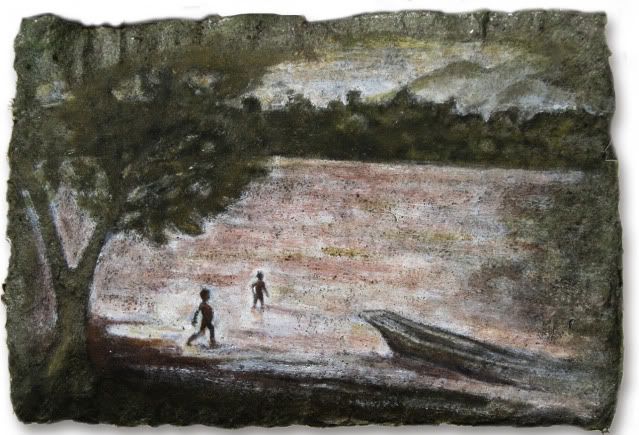
Art made from natural mineral pigments hand made on banana paper and canvas.
The art is for sale and 10% goes to the NGO Nawpa Runa (facebook) (blog) to create a medicinal plant book.

Click painting for larger viewWarmista Bonita
on canvas
50.5 x 70 cm
Abuela en el Castillo de Lamas
25 x 35 cm
SOLD

Polilla de la Noche
23 x 14 cm
SOLD
via Trueque in exchange for some
handmade pottery and donation to Nawpa Runa


Niño Curioso, Chazuta
14 x 23 cm
SOLD


Maribelle y su Hermano de Comunidad Nativa Chunchihui
50.5 x 70 cm


Niños en el Rio Huallaga, Chazuta
47 x 32 cm
SOLD


Sabiduria Lamista on canvas
28.5 x 36 cm
SOLD


*prices don't include shipping from CA


Art in progress and details shots


The Natural Pigments


I collected the rocks from a local river. The rocks are hand crushed and added to a binder to make paint. They are minerals and won't biodegrade or fade like plant colors. The banana paper is made by local women and this too will last just like any other paper. Of course, like any piece of art, be careful to keep out of direct sunlight.

As a new medium, there was a definate learning curve for me. Especially because some paint on very light or clear then dry much darker. I had to use many layers and wait for them to dry to see the results. The paint encouraged me to learn to paint in a new way.

The images of the paintings are done from photos that I took in the area and some are from a local professional photographer, Javier Quintana.


Trina, the founder of Sachaqa Centro de Arte, taught herself this technique of paint making and is now selling her natural pigment paints here

Some Thoughts

My airy loft/studio where the occasional giant deadly tarantula fell from the ceiling..no big deal.

One of the things my painting teacher, Lela Harty, told me when I picked up my first oil paints was that you can make art with a stick and mud if you know what you are doing. Well almost ten years later perhaps I can see it as a right of passage that I have literally accomplished this feat. Below is a series of paintings created out of natural paints made from clay rocks, picked from the waters of the Huallaga River in Northern Highland Amazon Jungle of Peru. They are hand crushed and applied to local handmade banana paper. A local artist, Trina Brammah, showed me where to find and create these paints myself. Trina also founded the sustainable Art Center Sachaqa that I have been working in.


My travels to get where I am now have been a journey of self discovery and revelation that will carry me to my future to come. For almost a year now I have been trekking sola from Colombia, through Ecuador to Peru, searching out alternative ways of living, building, thinking, being. I see the town I am in now, San Roque, as a wonderful rest point that has brought together my thoughts and skills attained on this search. Here I have been working full time to help build two houses using the local indigenous method of dried mud called Quincha. I also traveled to local farms to help with coffee harvesting.

In my spare time I have been experimenting with the local natural paints. My residence is a bamboo and leaf house at a spiritual center called Hunab-Ku. Here there is ample time to realize my ideals of acceptance, non-attachment, intuition, being, curiosity and excitment about life. A mix of strong community, connection to the land, and respect for nature makes this a fufilling environment. My days are full but I have never felt rushed through my tasks. I feel I have time, cook healthy meals, read, paint, sleep, hike and all the while ot seems as if I am just hanging out with friends and together we are helping each other manifest the life we envision. Returning to this mindset has reminded me of a natural flow and continuity in life can be achieved no matter where I am. Wise friends have told me, when you are in the right place, reaching your potential just flows and your goals are manifested, not perhaps without effort but without struggle. Everyday I feel I get closer to being in this right place.

The paintings themselves are a manifestation of my desire to create beauty that is derived more directly from nature. To see where all the materials come from and know they will go back someday not harming but enriching the earth. The colors of the river match the skin tones of the people here a reminder to me that we are all made of the same thing, we are all the same.

I am mailing my paintings home and selling my painting to help donate a portion to the Ñawpa Runa Foundation who supports the continuation of local art traditions such as pottery and paper making. Nawpa Runa has just started a project to create a book to share ancient medicinal plant knowledge. A medical student I met agreed to study under a woman in the region to learn and translate her knowledge into a book. I hope to help do the design and the proceeds made from the art will go to help publish the book.. If one piece speaks to you and you cannot pay I am open to Trueque (an exchange of goods, services or knowledge).

I hope you enjoy them and everyday find that space to match mind, body, and lifestyle.


Saturday, March 12, 2011

Leila's Finca, San Isidro, Ecuador


Finca San Pablo de LEA

San Pabalo de LEA is a milk farm located an hour or two east of the beaches of Jama, Canoa and Bahia. I spent two weeks here with Leila an energertic mother of two beautiful daughters Estephania and Amber. There are four generations on the farm and Leilas mother would cook us a traditonal and tasty lunch each day.

The work here was hard because of the heat but Leila is super laid-back and never made us work for too long when it was hot. Most of the work consisted of cutting pasto for the cows, milking the cows and creating a living fence out of Piñon tree. She also taught us how to make chocolate, cheese, ceviche from snails, and sweets from watermelon.


This is a living fence made out of Piñon trees. They are a laxative so the cows don't eat them and they can also be used as biodeisel. They are really easy to propogate just cut a branch and stick it in the dirt and they will grow roots very quickly. Fast, easy and pretty fence
We got some practice milking cows, it's a lot harder than it looks. Leila laughs a lot at our awkward and cluless attmepts at various tasks such as milking cows, cooking madura (a.ka burning bananas), and struggeling with the bugs with a cow poo, sweat and bruises...


Family and Friends

There are 4 generations of girls here at the farm. Leila explained to me that she makes about 170 litres of milk a day. From that she gains $24 and after paying the two workers at her farm she makes about $5 a day. Big companies like Nestle also come in and pay half of what the milk is worth. Despite this, compared to all the farms I have been to, she asked the least of us and gave the most. I also noticed that although there are difficulties with not having a stuffed bank account she has an incredibly rich life full of family freinds and food.

She also told me that a lot of the farmers here in San Isidro who grow yucca and watermelon are barely making any money. The soil is in bad shape now and the chemicals they need to buy to keep the plants gowing and the bugs away are very expensive. Without some help learning to make compost here I would think in a short time the soil will be no good at all.

Sleep over at the finca. A few times a week at least Leila or her girls have a gathering with lots of food.
This is a drink called Queidmada by setting fire to aguardiente and sugar. It is really really strong and good
More freinds at the house. The town of San Isidro is pretty small. Leila can walk next door to get the milk processed, across the street to get eggs and all the stores are within 6 blocks. There are two "clubs" for dancing in town, it is really safe and I like it better than the cities here.

Below a freind holds Amber's son, Adriano. Amber is young and the father is too. Another girl who lives at the farm is 14 and married with a baby as well. Although some young girls do not go to college who have babies Amber does because there is a ton of family and freind support the help with the baby. Abortion is also illegal here in Ecuador although a lot of people do it illegaly and probably at great risk to thier health. Here the whole family helps take care of the baby, the young guys here also seem to adore holding and being with the baby..something I definitly don't see too much in the states.


The other volunteer Ariana feasting on fresh crab at Leila's house.


Recipies

Ceviche de snail
Collect snails and feed flour to clean them out.
Then cook in bioling water for a minute de-shell and cut off the guts. Clean with lemon. Chop meat into bits and serve with onion, tomatoe and lemon
The left over guts..mmm

Cheese
Cheese is too easy to make. You just put a special packet of store bought bacteria in raw milk and let sit. Stir a bit and strain.


Chocolate
To make chocholate powder (for hot chocolate) and bars first we collected the Cacoa fruit. The seeds inside are covered by a white flesh that is really sweet, you can suck it off then roast the seeds stirring them in a pan or in the oven for an hour or so. Or alternativly you can let them dry in the sun for a few days.

Once they are evenly black you peel the shells off
Then you grind the beans with a ginder or you can use a blender or rock. Add a bit of egg, sugar and spices like cinnamon and 5 star anise.
Below Kasie, a peace corps volunteer who lives at the house, is using the grinder. She teaches health to the community and helps in a juvanile garden in town as well.

Then to make the bars you rool the mixture flat and let it dry a day. You can also add milk.
Watermelon peel candy
Just thinly slice the peel and cook in water and sugar...really good.


Animals at the farm

PicassoHatchi the ugliest cutest dog you´ll ever seeMinuit and Hatchi


Some things nearby

A reserve helping to protect the last remaining 2% of the most diverse coastal forests in Ecuador. You can volunteer here in a permaculture program for 1 or 2 months for $14/day.

30 min drive from Canoa, you can book a day and night for $20 or just stop by. It's a bit pricy but you can also volunteer here for $15 a day or so.


Friday, February 11, 2011

Rhiannon Community, peace and love


Rhiannon is a small cozy community in a small town San Juan, Malching, just 1.5h northeast of Quito. Everyone lives in the same house making it one big singing, praying, farming, vegan, warm and free-loving family.

When I arrived at night with 3 friends from Quito we were invited directly into a Tamascal ceremony. This would be my third experience and this time I actually liked it. Everyone was in their b-day suits, we didn't get the memo unfortunately, but at a lot of communities I have been to people are not as comfortable with this. Rhiannon is a bit different though, more relaxed. It is a very young community owned by British couple Nikki and Helen. Nikki has heaps of love and energy that is contagious throughout the community. This energy has fueled the project there since it began two years ago. I have to say they have been really successful so far being in desert climate with only 4 permanent residents and about 10-20 volunteers at a time.

One thing that is super rare now is that they are not out to get your money. They just ask for $25 a month for food. They get up about 5 work from 6 to lunch then relax. One thing I learned , though don’t take my work for it, is if you invest 25k in property in Ecuador you get citizenship along with it, not a bad deal.


After the Tamascal and prayers we had a jam session with a violin, guitar, drums and glass bottles. At this point there was no electricity but I have a hard time imagining the hosue without the charm of the candleight.

Inside is warm and cozy
When I first arrived it was at night. Sitting in the pitch black, steamy warm Tamascal with my mind drifting off to the end of the universe, I did not realize that Rhiannon sits at the edge of the earth with the most fantastic view of Quito, snow topped volcano of Cotopaxi and beyond.

Projects

Solar panel project made from reclaimed steel to hold large solar panels, generating enough power for the house.

They are fixing a waste water pond because it has been leaking. This pond will break down the communities waste and let the water at the top evaporate out just like the one at Arcosanti.

greenhouse
orno
They move the chickens and pigs around the farm to graze the land and will use the manure for a biogas generator they plan to build. There are gardens with veggies the feed the community, a greenhouse and awesome dry toilets with hot showers from solar power.
They also have about 7 dogs and a few cats :)